

Whenever you are on the internet, you use a system that is invisible; it is known as Domain Name System (DNS). Imagine that it is the phonebook of the internet. Words are used by humans to search the websites and numerical strings are used by computers. DNS is an interpreter of the two. Check out How to Turn On Private DNS for Free on Android Phone.
What is DNS?: The briefest explanation of it would be: Imagine you have a friend and you know his or her name only. You look up their street address in a phonebook. The name of the friend in this analogy is the web site name, the phonebook is the DNS and the street address that the computer uses to get to the destination is the IP address.
This translation operates in the following way with real-life examples, as seen in the table below:
| Human-Friendly Names | Computer-Friendly IP Addresses |
makeuseof.com | 123.45.67.89 (Placeholder example) |
google.com | 142.250.190.46 (Actual Google IP) |
Why Speed Matters: The “Cold Start” Advantage
A rapid DNS will minimize once the delay to the commencement of a webpage. This becomes particularly vital during the first time that a search is made by a browsing session, the so-called Cold Start. When the DNS server is slow you wait when using the browser, which causes a delay to be felt even when it is a high-speed fiber internet.
After a site has been found the device will store its numerical address temporarily. This makes it much faster when it comes to repeat visits since the time spent on the look up is practically zero. Nevertheless, due to the fact that a modern web page can require dozens of different domains to load some data at the same time, the solution to a responsive internet is a high-performance middleman of the initial requests.
Since it is this translation process on which all the clicks are based, the initial step to optimization is assessing the current level of performance against the global leaders.
The Toolkit: Comparing DNS Testing Methods
To achieve optimal work at home, it is necessary to apply special tools that measure the response times.
As an expert, I would suggest two strategies to follow, namely global analytics to obtain a general level of reliability and local benchmarking to obtain a more specific result.
| Criteria | DNSPerf | DNS Speed Test Benchmark |
| Methodology | Continuous global monitoring from 200+ locations; tests every minute with a 1-second timeout. | Local browser-based DNS-over-HTTPS (DoH) queries sent from your specific device. |
| Best Use Case | Comparing long-term provider reliability and global infrastructure rankings. | Finding the absolute fastest server for your current location and ISP routing. |
| Key Feature | Filters by continent and provider type (Authoritative vs. Resolver). | “Check DNS Speed” button with a clipboard copy feature for instant setup. |
The Significance of Local Testing.
Whereas a provider may be rated as number one in the world on DNSPerf, the rankings are averages. Global leader can fail to perform well on you due to local network conditions, routing practices of your ISP and distance. A local test checks the real latency of the distance between your desk and the DNS server so that you do not fall into the trap of selecting a reputable server which is too distant.
Now that you have the right tools in mind, it is time to leave theory behind and start practical tests that will help you to find the best provider.
Step-by-Step: Measuring Your DNS Performance
Using the DNS Speed Test Benchmark tool is the most accurate way to see which provider wins in your neighborhood. Follow these steps to generate your performance profile:
- Open the Tool: Navigate to the benchmark website in your preferred web browser.
- Start the Test: Click the Check DNS Speed button.

- Allow the Phases: Let the tool complete its Warm-Up Phase before you begin analyzing numbers.
- Identify the Leaders: Look for the table that populates with various providers (e.g., Cloudflare, Google, Quad9).

- Analyze the Latency: Focus on the Min, Median, and Average ms (milliseconds) columns. Lower numbers represent faster performance.
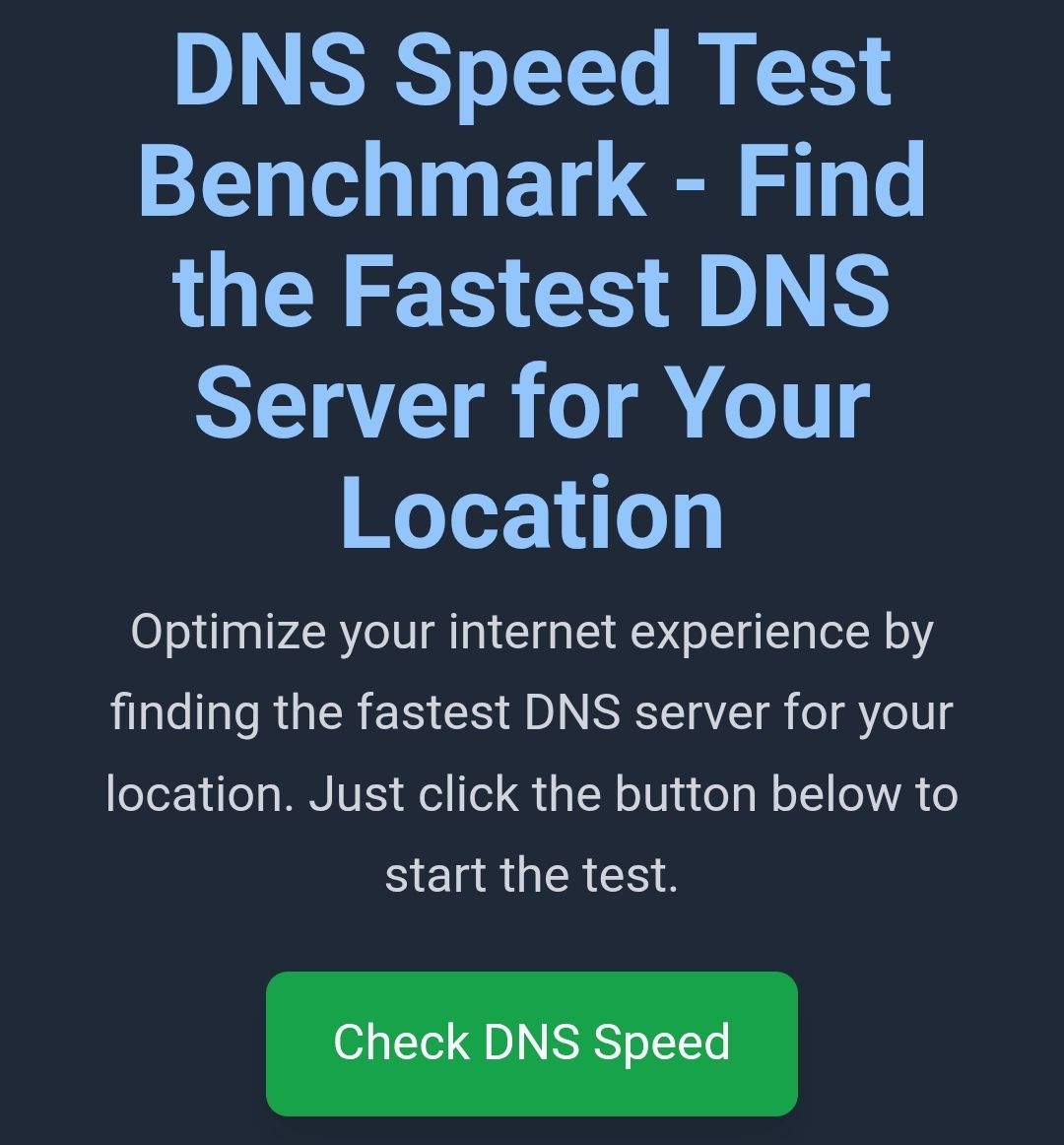
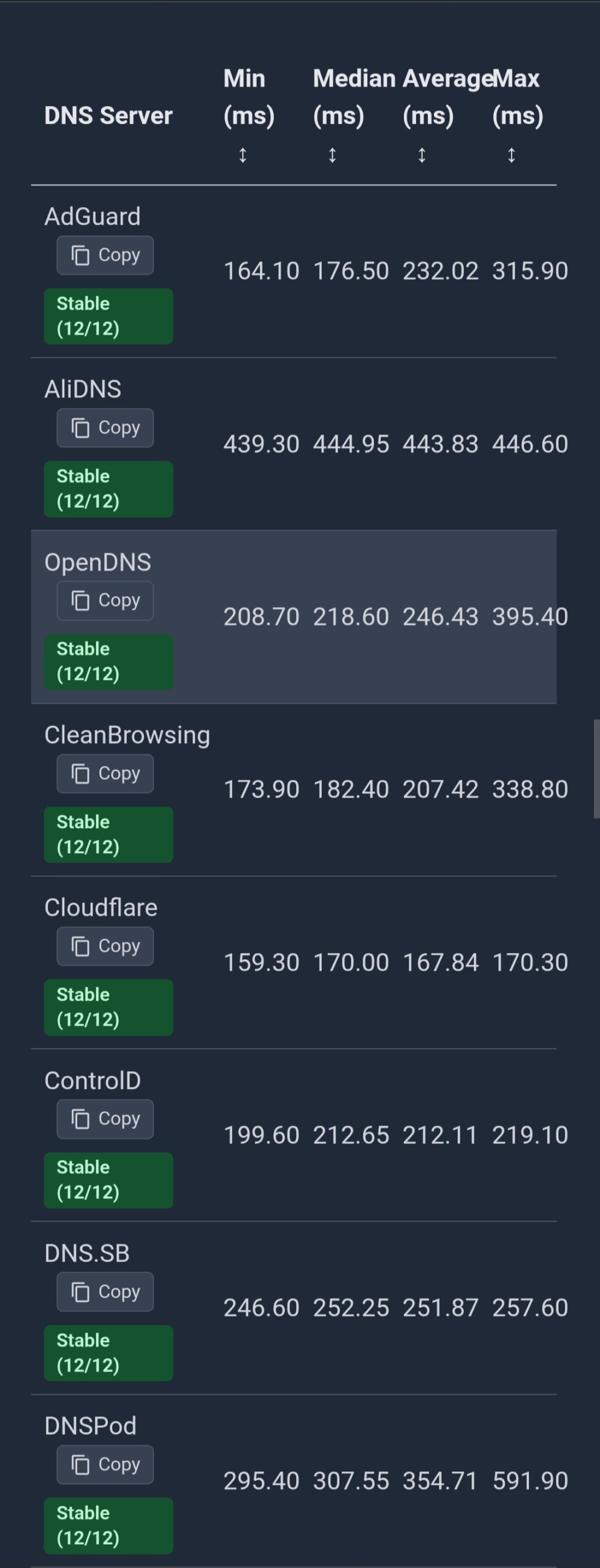
Pro-Tip: Understanding the Numbers. The tool begins with a Warm-Up Phase. This pre-emptively establishes connections and the caches such that TCP and TLS handshakes do not slacken future queries. Since the test is based on a browser, the scores are displayed as comparative scores and not as absolute values. As an illustration, you may observe 30ms as opposed to 10ms on the command line; the overhead of the additional HTTP and TLS overheads to support insecure DNS-over-HTTPS.
What counts as a “Good” Speed? The current standards in the world of public resolvers provide the approximate query times which can be used as a high-performance lower limit:
- 1.1.1.1 (Cloudflare): ~11.22 ms
- FlashStart: ~13.78 ms
- Quad9: ~16.41 ms
- Google: ~19.40 ms
- Cisco Umbrella: ~21.35 ms
Identifying the fastest address is only half the battle; now we must apply that speed to your hardware.
Hands-Hands Implementation: Updating Your Network Settings
Updating your DNS is a simple software tweak that requires no new hardware. Here is the precise process for updating settings on a MacBook:
- Click the Apple icon in the top-right corner of your screen and select
System Settings. - Select
Networkfrom the left-hand sidebar. - Locate your active Wi-Fi connection and click the
Details...button next to it. - Choose
DNSfrom the sidebar of the popup window. - Under the DNS servers section, use the
+button to add your new DNS address. - Use the
—button to remove any old, slower addresses. - Crucial Step: Save your changes by clicking the OK button.
Efficiency Tip: Use the Clipboard feature in your testing tool to copy the fastest DNS address. This eliminates the risk of typos, which are the most common cause of configuration failure.
Configuration is only half the battle; ensuring your connection remains stable and actually improved is the final priority.
Safety First: Troubleshooting and Caveats
While changing DNS is a safe optimization, a “Specialist” mindset requires verifying your work to avoid the “Latency Trap.”
“Before You Save” Checklist:
- [ ] Verify the Entry: Is the numerical address exactly as it appeared in the test?
- [ ] Check the Delta: Is the new server significantly faster than your ISP’s default (usually the first entry in your test list)?
- [ ] Log the Original: Do you have the original settings written down if you need to revert?
WARNING: In case you enter a malfunctioning DNS IP or remove crucial entries then your internet connection would not work.
The problem of websites ceasing to load immediately after the change indicates that your computer is not connected to the new server.
The Latency Trap: Do not select a provider based on their brand. When the server of the provider is more distant to you when compared to the local server of your ISP, then your data will travel farther. The increased trip time increases latency, and browsing appears slower following an alleged upgrade. Use the local standards, but not international ratings.
The point of reassurance: That is all reversible. In case of loss of stability, revert to the Network settings and revert to the default settings of your ISP.
Final Learning Narrative: Find your silent middleman and adjust your settings (spend five minutes). This removes unwarranted latency at a network heart. The smoother the browsing process is, the faster the DNS, and it was demonstrated that sometimes a simple adjustment, rather than an expensive data plan, is all that is needed.
Discover more from Cloudorian — Android, Samsung & Windows How-To Guides
Subscribe to get the latest posts sent to your email.