

Last Updated on 18 Aug, 2026 by Montel Anthony
Most Android users scroll right past Quick Share without a second thought. Learning how to use Quick Share on Android means you stop emailing files to yourself, stop waiting on cloud syncs, and start transferring photos, documents, and links in seconds. This guide covers every step, from basic setup to sharing files directly with iPhones via AirDrop. You’ll also get a look at what’s coming next, including a tap-to-share feature that could change file sharing on Android for good. See How to Share Files Between Android and Windows Using Nearby Share.
Key Takeaways
- Quick Share works on Android 6.0 and above across phones, tablets, and Chromebooks
- You can transfer files to Windows PCs using a free Google app
- Pixel 9 and Pixel 10 series users can now share files directly with iPhones via AirDrop
- A system-level “Tap to Share” feature powered by NFC is currently in Android 17 testing
Quick Share started life as Samsung’s own file-sharing tool back in 2020. In January 2024, Google and Samsung announced that Samsung’s existing Quick Share would be unified with Google’s Nearby Share under the Quick Share brand, with the goal of providing a single, system-level sharing experience across Android phones, ChromeOS devices, and compatible Windows PCs.
The result is a tool that now works on virtually every Android device. Quick Share is available on Android 6 and later, ChromeOS 91 and later, and 64-bit versions of Windows 10 and later.
How It Actually Transfers Your Files
Quick Share does not rely on your internet connection. Quick Share uses Bluetooth or Bluetooth Low Energy for initial discovery and authentication, then establishes a direct Wi-Fi link between devices for the actual data transfer.
No signal? No problem. Quick Share works without an internet connection, transferring over Bluetooth, meaning you can send and receive files on a plane, a train, or completely off the grid.
Quick Share handles far more than just photos. You can send:
- Photos, videos, and documents
- PDFs and full folders
- App links, web URLs, and contacts
- Spotify tracks and social media posts
- Clipboard content on select devices
Users can send files to up to 8 nearby devices at a time, so long as those devices have the feature enabled and their screens are on.
Before anything else, you need to turn Quick Share on. The steps below work the same way on Google Pixel, Samsung Galaxy, and OnePlus devices.
Step-by-Step Setup
- Swipe down twice from your home screen to open Quick Settings.
- Tap the Quick Share tile.

- Select Who can share with you.

- Turn on the toggle for Visible to nearby devices.
- Set your visibility preference (Contacts only, Everyone for 10 minutes, or Your devices).
- Tap Done, then Continue.
- Make sure Bluetooth is on.
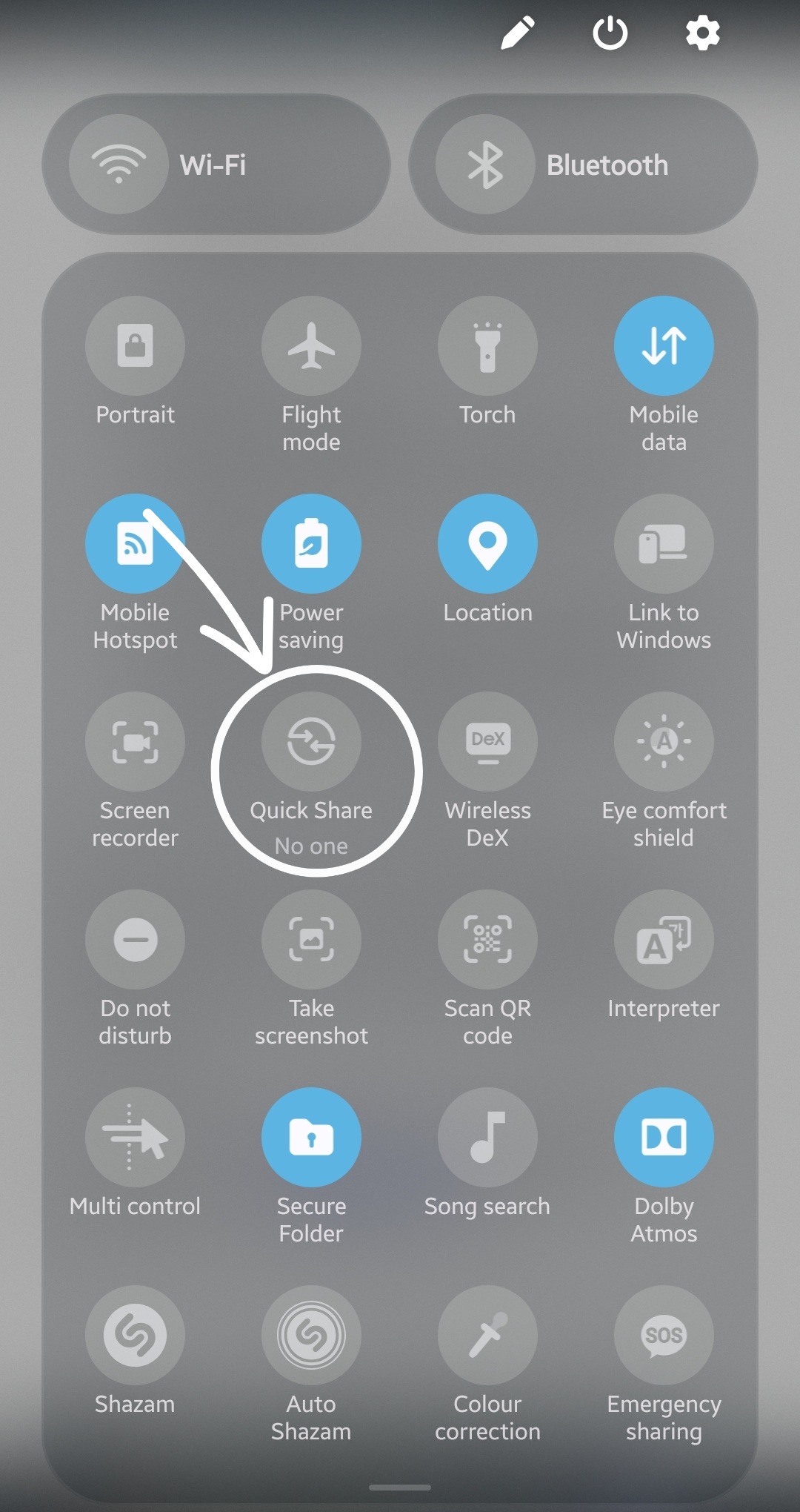
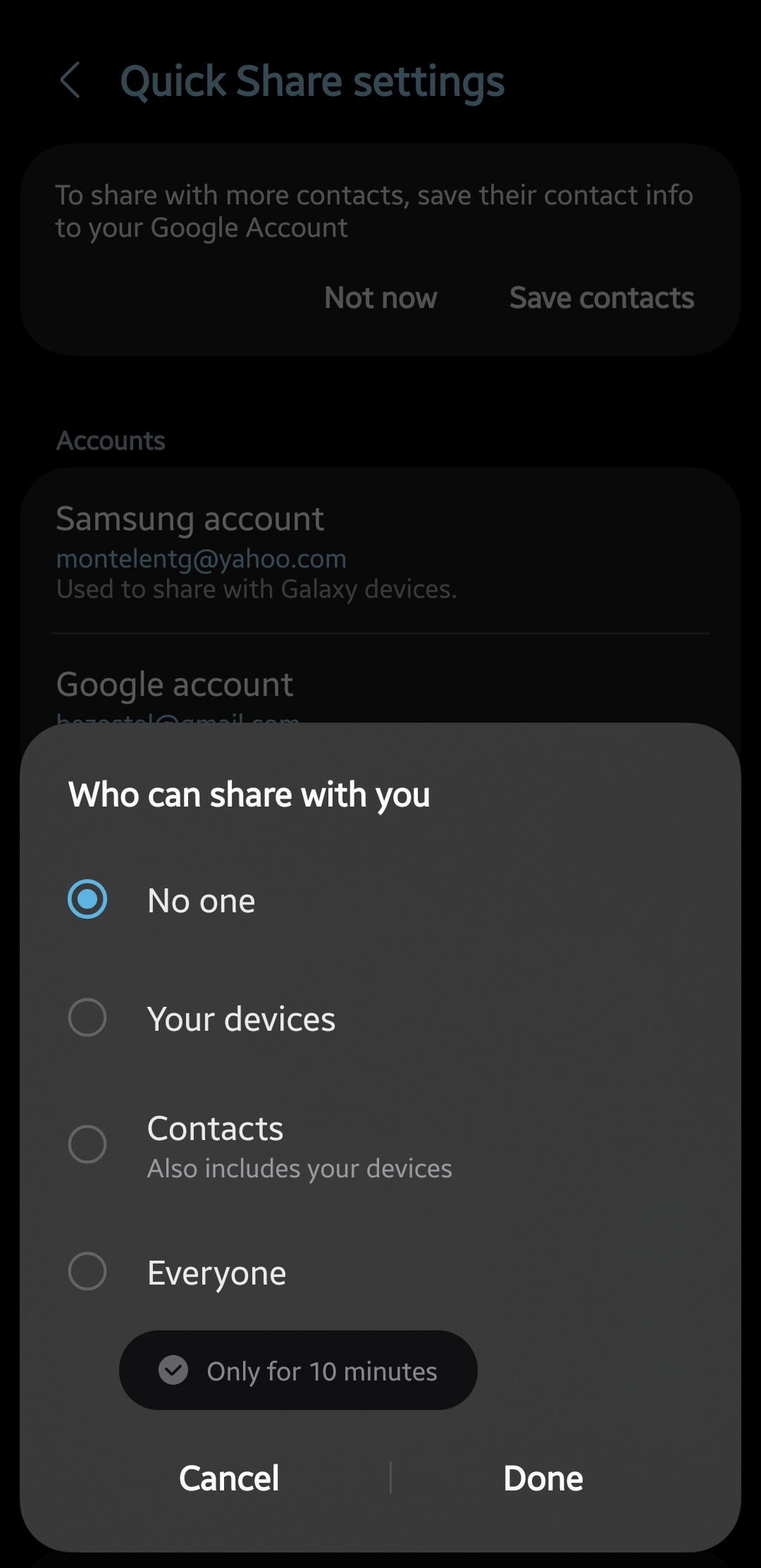
Quick Share is now active. Your preferences stay saved until you change them.
Choosing the Right Visibility Setting
Your visibility setting controls who can see your phone in nearby device lists. Here’s a breakdown:
| Setting | Who Sees Your Device |
|---|---|
| Your devices | Only devices linked to your Google account |
| Contacts only | Anyone saved in your Google contacts |
| Everyone for 10 minutes | Any nearby device for a short, timed window |
| No one | Your device stays hidden |
“Everyone for 10 minutes” is your best pick when sharing with someone new. It mirrors AirDrop’s own open-discovery limit, which Google adopted as a deliberate privacy improvement in early 2026.
Once Quick Share is active, transfers take just a few seconds.
- Open the photo, document, or link you want to send.
- Tap the Share button.
- Select Quick Share from the sharing options.
- Choose the nearby device from the list.
- Wait for the recipient to tap Accept.
The recipient’s screen must be on and Quick Share must be set to a visible mode for their device to appear in your list. If their phone doesn’t show up, ask them to open Quick Share from their Quick Settings panel.
Here’s something most Android users have never heard of. You can already trigger a Quick Share transfer by physically tapping two phones together.
This functionality has existed within Quick Share since it was actually referred to as Nearby Share. If you tap the backs of two Android devices together while one is attempting to share a file through Quick Share, it should automatically complete the connection.
Sharing between devices from the same manufacturer is easy enough, with transfers between a Pixel 10 and Pixel 10a working reliably, though cross-brand recognition between a Pixel and a Galaxy S26 can be inconsistent.
A more polished version is on the way. References to a system-level service called “TapToShare” have appeared in Android 17 beta and Canary builds, sitting at the OS level rather than inside any manufacturer’s skin. Samsung’s One UI 9 already carries an explicitly named “Tap to share” option inside Quick Share, with the description “Just hold the top of your phone close to the device, and the files will be sent.”
The feature appears to use NFC as a trigger while Quick Share handles the transfer, and evidence suggests it may roll out across Android devices, not just Samsung phones.
This is where things get genuinely interesting. For years, moving a file from Android to iPhone meant cloud storage workarounds or emailed attachments. That has changed.
Which Devices Support It Right Now
Quick Share’s AirDrop interoperability, which launched as a Pixel 10 exclusive in late 2025, has since been officially extended to the Pixel 9 series, enabling peer-to-peer transfers to iPhones, iPads, and Macs without routing data through servers.
Google VP of Engineering for Android Eric Kay confirmed that Quick Share’s AirDrop interoperability would expand to “a lot more devices” in 2026, with OEM partners involved.
How to Send a File from Android to iPhone
- On the iPhone, open Settings and go to General > AirDrop.
- Set AirDrop to Everyone for 10 Minutes.
- On your Pixel 9 or Pixel 10, open the file you want to share.
- Tap Share, then select Quick Share.
- Choose the nearby iPhone from the device list.
- The iPhone user taps Accept on the AirDrop prompt.
The file transfers directly between both devices. No accounts needed. No server involved.
How to Receive Files from an iPhone on Your Android
- Open Quick Share on your Android phone from Quick Settings.
- Set your visibility to Everyone for 10 Minutes.
- Ask the iPhone user to AirDrop the file to your device name.
- Tap Accept when the prompt appears on your screen.
Files land in your Downloads folder automatically.
For a full breakdown of how Google’s Quick Share and AirDrop work together technically, Google’s official resource at android.com/better-together/quick-share is worth bookmarking.
Chromebook owners can send and receive files from their Android phone without any extra apps. Here’s how to set it up:
- Open Settings on your Chromebook.
- Go to Connected devices and find Quick Share.
- Tap Set up next to Quick Share.
- Enter a device name and choose your visibility settings.
- Tap Confirm.
After setup, share files exactly as you would from a phone. Pick any file, tap Share, choose Quick Share, and select your Chromebook. You can disable Quick Share from the same settings menu and re-enable it any time.
No more emailing files to yourself or dealing with the Cloud. Quick Share lets you transfer photos, videos, documents, or entire folders between your Android and Windows devices with ease.
Windows Setup Steps
- Download the Quick Share app for Windows from Google’s official site.
- Open the app and click Sign in (or skip sign-in to use without a Google account).
- Enter a name for your PC so it shows up on your phone’s device list.
- Click Visible to others as and set your visibility preference.
- Right-click any file on your phone and select Quick Share to send.
Your Windows PC needs both Bluetooth and Wi-Fi enabled for Quick Share to work. The app supports Windows 10 (64-bit) and Windows 11.
Quick Share can be stubborn at times. These fixes cover the most common problems:
- Device not appearing in the list: Confirm that Bluetooth and Wi-Fi are both active on both devices. Make sure the recipient’s screen is unlocked and their Quick Share visibility is not set to “No one.”
- Transfer is slow or stuck: Move both devices within a few feet of each other. Wi-Fi Direct works best at close range.
- iPhone not appearing: The iPhone must have AirDrop open and set to “Everyone for 10 minutes.” Your Android device must be a Pixel 9 or newer to share with iPhones.
- Transfer is rejected automatically: Ask the recipient to check their Quick Share visibility setting and confirm they are not blocking incoming shares.
Restarting Bluetooth on both devices clears most connection issues.
Quick Share is gaining ground fast as Android’s answer to AirDrop. Here’s what’s confirmed or actively in development:
- AirDrop cross-sharing expanding to more Android OEM devices through 2026, confirmed by Google’s VP of Engineering
- Tap to Share via NFC, found in Android 17 Canary builds, allowing file transfers by simply holding two devices near each other
- Gesture Exchange, spotted in Google Play Services code, pointing toward contact-sharing similar to Apple’s NameDrop
- Cross-account transfer confirmations being tested in Google Play Services beta builds for added security between different Google accounts
Quick Share has a chance to become the staple Android feature it should always have been, particularly with recent and upcoming updates that address both reliability and awareness.
For ongoing coverage of Android tools and updates, visit cloudorian.net for regular breakdowns as features roll out
Discover more from Cloudorian — Android, Samsung & Windows How-To Guides
Subscribe to get the latest posts sent to your email.