Last Updated on 13 Aug, 2026 by Montel Anthony
If your Android phone used to feel instant but now takes ages to open apps, hangs Chrome on a blank page, or throws constant storage warnings, you are not alone, and the fix is usually simpler than you think. To clear cache on an Android phone, start with per-app cache clears, move to Chrome’s browsing data if the web feels broken, and only escalate to a system cache partition wipe when troubleshooting post-update issues. A common culprit behind these slowdowns is cached files that have quietly piled up, though low free storage, background processes, and buggy apps can also play a role.
Cache is a convenience layer. Apps and browsers store images, scripts, and bits of data so they can load faster next time. Over weeks and months, those temporary files swell, eat storage, and sometimes break the very experiences they were meant to speed up.
At Cloudorian, readers ask about Android cache cleanup every week. This guide walks you through clearing an app’s cache, erasing Chrome’s browsing data, and, when it makes sense, wiping the system cache partition. You will also learn the key difference between clearing cache and clearing storage, so you fix what is slow without losing what matters.
Why cached data builds up and actually slows your phone
Cache exists to make things feel snappy. Apps save thumbnails, scripts, and other assets locally so they do not need to fetch everything from the network each time you open a screen. That speed boost has a cost, though. A gallery app that starts with a few megabytes of thumbnails can quietly balloon to hundreds of megabytes, and social apps often grow even larger as you scroll, research suggests social app caches can reach 500 MB to 2 GB on active devices, with total device cache sometimes exceeding a few gigabytes. For a practical look at how much smartphone storage you might actually need, see how much smartphone storage you need.
When storage gets tight, Android slows down system-wide. Pages reload too often, apps hesitate at launch, and storage alerts appear even when you have not installed anything new. None of this is a flaw; it is simply how caching works. Clearing cache on individual apps when they misbehave, or clearing browser cache occasionally, keeps things running smoothly, though a system cache partition wipe is better reserved for targeted troubleshooting after an update rather than routine maintenance. If your device seems full despite not installing many apps, our guide Why Your 128GB Phone Is Actually Full (And the Minimalist Apps That Can Fix It) explains common causes and quick fixes.
How to clear cache on an Android phone: per-app steps
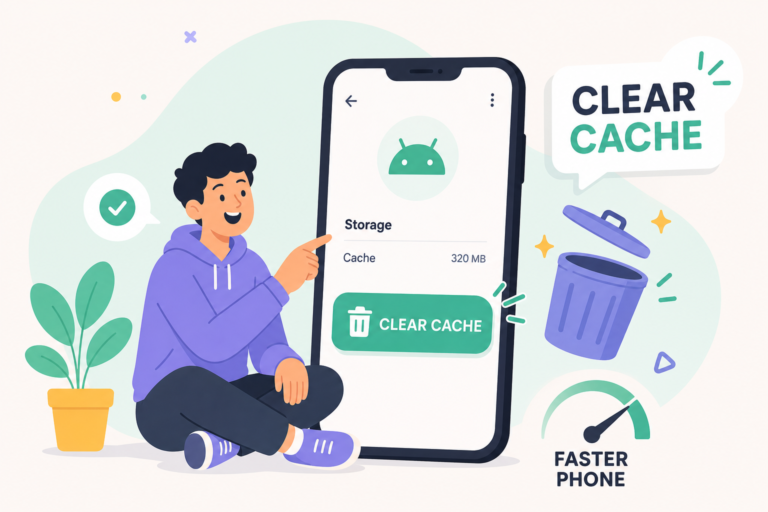
Clearing an app’s cache is the fastest, safest fix for one misbehaving app. It deletes temporary files only, then lets the app rebuild what it needs the next time you open it. Your logins, settings, photos, and messages stay untouched.
- Open Settings.
- Tap Apps or Apps & notifications, then See all apps if needed.
- Select the app you want to fix.
- Tap Storage or Storage & cache.
- Tap Clear cache.
Labels vary slightly by Android version, but the path is consistent across most devices. The app may open a fraction slower on its first launch as it rebuilds fresh cache, then performance should return to normal. On Samsung Galaxy phones running One UI, the steps are nearly identical: Settings → Apps → select the app → Storage → Clear cache. Some models offer a Device Care shortcut that surfaces storage and memory tools, but the per-app cache button still lives inside each app’s Storage screen.
Worth noting: current versions of Android do not include a single built-in button to clear the cache for all apps at once (per Google’s own Android support documentation). If you want a broader sweep, repeat these steps for your most-used apps, or move on to the advanced options below.
Clear cache vs. clear storage: know the difference before you tap
Clear cache removes temporary files only, cached images, scripts, and short-term data the app can regenerate on its own. Clear storage (sometimes labeled Clear data) erases everything the app has saved locally: accounts, preferences, databases, and offline content, returning it to a first-run state. For more background on the difference between cache and storage on phones, see the explainer linked here.
Use clear cache first when an app glitches, shows outdated content, or is hogging space. Consider clear storage only when an app is deeply broken, you are removing an account from the device, or other fixes have already failed. Avoid using Clear storage on banking apps or password managers unless you have account recovery options or credential backups in place, multi-factor authentication recovery codes and password manager sync are good fallbacks if you do need to reset one of these apps. As a broader rule, clearing cache on Android does not delete your photos, contacts, or personal files.
How to clear Chrome’s browsing cache on Android
Chrome manages much of its own data independently, so the most reliable way to refresh it is inside the browser itself. This is where you remove cached images, files, and cookies that can cause broken pages or persistent sign-in issues (see Android’s guide on clearing cache and cookies for the basics).
- Open Chrome, tap the three-dot menu, and go to Settings.
- Tap Privacy and security, then Delete browsing data.
- Choose a time range. Pick All time for a complete reset.
- Check Cached images and files. Add Cookies and site data if you want to sign out of most sites.
- Tap Delete data.
According to Google’s Chrome Help documentation, clearing cookies signs you out of most websites but does not sign you out of your Google Account in Chrome itself. Start with cache-only if pages render strangely or feel sluggish, then add cookies when you need to reset a stubborn site session. If only one site is misbehaving, you can be surgical about it: open the page, tap the padlock or info icon, then Cookies and site data to remove just that site’s cookies without touching everything else. If Chrome still won’t load pages correctly after these steps, follow our troubleshooting guide: How to Fix Google Chrome Not Loading Pages on Android (10 Best Ways).
Clear cache on Android phone, system cache partition guide
Wiping the system cache partition is an advanced troubleshooting step. It clears Android-level temporary files without erasing your photos, apps, or personal data. Use it when the phone behaves strangely after a software update, random reboots, freezes, excessive battery drain, or a sluggish boot. Think of it as a targeted fix rather than a routine task.
- Samsung: Power off the device. On many newer models, you may need a USB-C cable connected to a computer first; then hold Volume Up + Power to enter recovery. (Button combinations and USB requirements vary by model and software version, check Samsung’s support page for your exact device.) Use the volume keys to highlight Wipe cache partition, press Power to confirm, choose Yes, then select Reboot system now.
- Pixel: Power off, then use the device’s recovery button combination to enter Android Recovery. Select Wipe cache partition if the option appears, confirm, then reboot. Many recent Pixel models, including those in the Pixel 9 series, no longer include a “Wipe cache partition” option in recovery, as Google’s community documentation confirms the feature was removed for these devices.
- OnePlus: Power off, hold Power + Volume Down to enter recovery. Choose Wipe data & cache, then Wipe cache, confirm, and reboot.
On many modern devices the recovery menu no longer includes a cache partition entry at all. If you do not see it, that means Android is managing system cache automatically on your device, you can skip this step entirely. After a successful wipe, choose Reboot system now and test the phone. If issues persist, update your apps, free up storage space, or consider a full factory reset only as a last resort.
Real-world results: how one Cloudorian reader fixed a phone everyone else said was broken
A reader with a mid-range Android phone wrote in because their device had become almost unusable. Apps took around 10 seconds to open, Chrome crashed several times a day, and the Storage screen showed 4 GB used with no clear source. They had already tried restarts and uninstalled a few apps without improvement, and local repair shops were recommending a battery replacement or a full factory reset.
Following Cloudorian’s Android optimization checklist, they cleared cache on their 12 most-used apps, ran a full Chrome browsing data clear, then performed a system cache partition wipe after confirming a recent OTA update had installed. The whole process took around 15 minutes. Just over 2 GB of storage returned, app launch times improved noticeably, and Chrome stopped crashing. Results like these are not guaranteed, outcomes vary by device, how much cache has built up, and what is causing the slowdown, but this reader’s experience shows how effective a methodical cache clear can be before reaching for more drastic options. The same steps in this article are what solved it.
Conclusion
When troubleshooting performance, keep three levels in mind: per-app cache clears for targeted fixes, Chrome browsing data for web issues, and a system cache partition wipe reserved for post-update problems at the OS level. Knowing how to clear cache on an Android phone, and when to use each method, means you can resolve most slowdowns in minutes without risking any personal data.
The distinction worth remembering: clearing cache is generally safe and temporary (clearing app data or storage for certain system apps can have unintended effects, so use that option deliberately), while clearing storage resets the app completely and should always be intentional. Many cache-related fixes are quick and free, often taking only a few minutes, though the time and results depend on your device and how much cache has accumulated.
If this helped, check out Cloudorian’s other Android how-tos, performance guides, and gear reviews. We keep our guides current so you can spend less time troubleshooting and more time actually using your phone. You may also find our Windows guide useful for system-level cache issues: How to Clear Your Update Cache on Windows 11 & 10.
{ “@context”: “https://schema.org”, “@type”: “Article”, “datePublished”: “2026-06-01T11:01:07.850Z”, “dateModified”: “2026-06-01T11:01:07.859Z”, “headline”: “How to Clear Cache on Your Android Phone (Step-by-Step)”, “description”: “Learn how to clear cache on your Android phone: per-app, Chrome, and system partition. Free up space, fix slow apps, and stay safe doing it.”, “publisher”: { “@type”: “Organization”, “name”: “Cloudorian” }, “mainEntityOfPage”: { “@type”: “WebPage”, “@id”: “https://www.cloudorian.net/clear-cache-on-android-phone/” }, “image”: [ “https://www.cloudorian.net/wp-content/uploads/2026/06/how-to-clear-cache-on-your-android-phone-step-by-step-1780229063876.png” ], “url”: “https://www.cloudorian.net/clear-cache-on-android-phone/” }Discover more from Cloudorian — Android, Samsung & Windows How-To Guides
Subscribe to get the latest posts sent to your email.
